Beyond the Sahasrara — An Introduction to the Four Divine Chakras
Shri Mataji did not keep these chakras “mysterious” or “secret” because She did not wish to reveal them, but because ordinary human intellect and language cannot fully express them. They are matters of experience. They are states of consciousness where there is no longer an individual “you”; there is only “God.”
These four chakras are not situated one above another in the same way as the chakras from Mooladhara to Sahasrara. Rather, they represent the expansion of consciousness above and around the Sahasrara. To understand them, we must move beyond linear thinking.
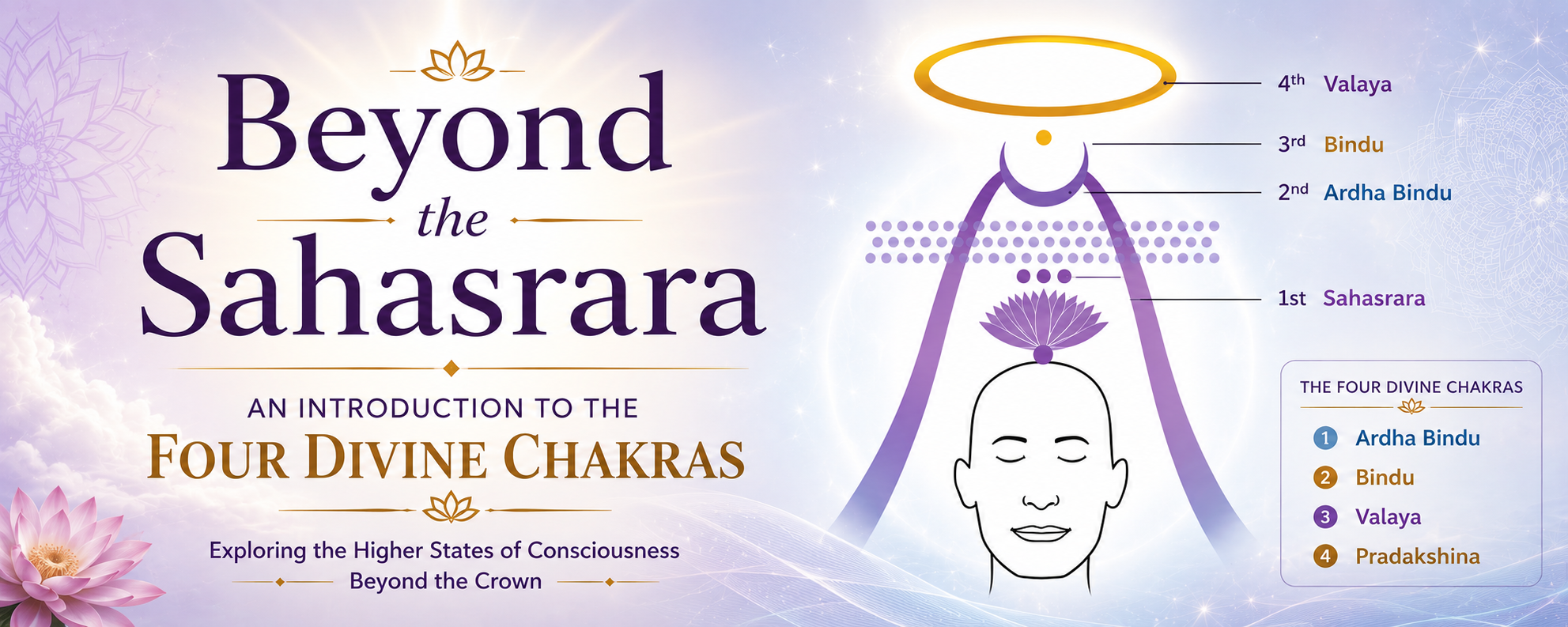
The Four Divine Chakras Are:
- Ardha Bindu
- Bindu
- Valaya
- Pradakshina
Let us now explore these four states in greater depth, in the light of the knowledge given by Shri Mataji.
1. Ardha Bindu Chakra — The Half-Dot / The Crescent
Meaning and Concept
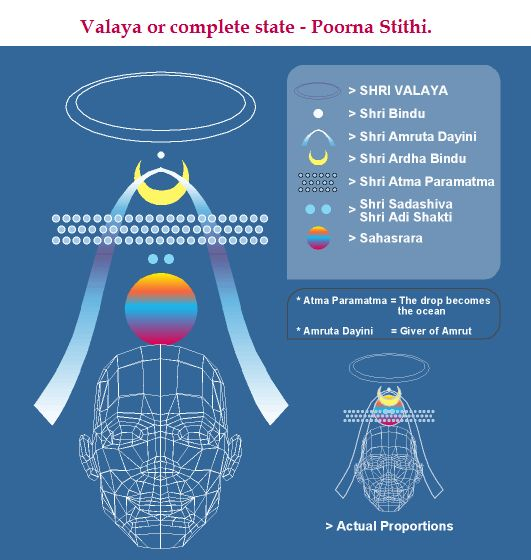
The literal meaning of Ardha Bindu is “half a dot.” It is shaped like the Moon—a crescent. It represents the first state of consciousness above the Sahasrara. It is a state of transition—the first step from individual consciousness towards collective consciousness.
Shri Mataji described this as the abode of the highest form of Mahakali. Here, Mahakali is not present in Her destructive aspect, but in Her supremely auspicious, nurturing and blissful form.
It is the purest expression of the Divine Power of Desire. But this is no longer personal desire; it is the desire of the Divine:
“May everyone attain their benevolence and well-being.”
Experience and Function
A. The ultimate state of witnessing:
At Sahasrara, we learn to become the witness. At Ardha Bindu, we become the witness itself. The distinction between the observer and the observed begins to disappear. You no longer merely watch life; you enjoy the Divine play. There is no reaction, no analysis—only pure joy.
B. Complete satisfaction and bliss:
This is the state in which desires come to an end because the Spirit, established in its true nature, experiences supreme bliss. No material or emotional craving remains.
C. Auspiciousness:
This chakra is connected with everything that is auspicious. When a person’s consciousness reaches this level, their very presence becomes auspicious. The atmosphere around them becomes pure and positive. Such a person becomes, as it were, a living place of pilgrimage.
D. Purification of the Ida Nadi:
This chakra governs the highest point of the left channel, the Ida Nadi, which is associated with our desires and our past. When consciousness reaches Ardha Bindu, past conditionings, impressions and emotional burdens are burnt away. The individual becomes completely free from the past.
Meditation at This Level
One does not attempt to “meditate upon” this chakra. Rather, it is a state into which one enters.
Method: Go deeply into thoughtless awareness during meditation. Place your attention at the Sahasrara and pray to Shri Mataji:
“Mother, please make me the witness. Please dissolve all my desires into Your Divine Will.”
Mantra: The Mahakali mantra may be very effective here, but it should not be repeated mechanically. The feeling should be one of bowing before that supremely auspicious Divine Power.
Experience: When consciousness touches this state, the seeker may experience profound, unfathomable peace and joy. A strong coolness may be felt towards the left or back of the head. It may feel as though one were looking upon a pristine lake on a tranquil moonlit night.
Ardha Bindu is the threshold where the individual begins surrendering his or her personal existence at the feet of the Virata.
2. Bindu Chakra — The Dot
Meaning and Concept
Bindu means “a point” or “the Dot.” It is the centre from which the whole of creation expands. If Ardha Bindu is the Moon, then Bindu is the Sun. It is the nucleus of Supreme Consciousness.
Shri Mataji described it as the abode of the highest form of Mahasaraswati. It is the source of the Divine Power of Action and Creation. From here flows all Divine knowledge, art, science and creativity.
It is the point where Divine Desire—which arises in Ardha Bindu—is transformed into action. It is the abode of the Virata, the Adi Purusha.
Experience and Function
A. Source of Divine creativity:
A yogi who reaches this state does not personally “do” anything. The yogi becomes an ideal channel for the Divine Power of Action. Through such a person, the purest forms of poetry, music, art, science and spirituality manifest. The verses of Kabir and the music of Mozart are given as examples of creativity flowing from this Bindu.
B. The state of non-doership:
The individual becomes completely free from the feeling, “I am doing this.” There is a clear experience that another, Divine Power is working through them. The person is merely like a flute—the One playing the flute is someone else.
C. Freedom from the future:
This chakra governs the highest point of the right channel, the Pingala Nadi, associated with action and future planning. When consciousness reaches Bindu, anxieties about the future, excessive planning and ambition disappear. The individual becomes established in the present moment, knowing that whatever action is taking place is unfolding according to the Divine Plan.
D. Experience of the Virata:
At this level, the seeker becomes aware of the Virata and experiences themselves as an inseparable part of that Collective Being—like a cell within the greater body. The same consciousness begins to be perceived in everyone.
Meditation at This Level
Again, one does not try to meditate “on” it; rather, surrender is required in order to dissolve into it.
Enter deep thoughtless awareness and place the attention at Sahasrara. Pray to Shri Mataji:
“Mother, please make me Your instrument. May You alone work through me. Please make me a non-doer.”
Mantra: The Mahasaraswati mantra may be helpful here. The inner feeling should be one of complete humility before the Supreme Creative Power.
Experience: The seeker may experience tremendous energy and inspiration, yet this energy remains peaceful and free from ego. Intense coolness or light may be experienced towards the right side of the head or at the centre of the crown. There may also be a sudden understanding of a complex subject or an unexpected artistic inspiration.
Bindu is the state in which the individual becomes the “hand” of God, through which Divine work is accomplished.
3. Valaya Chakra — The Circle
Meaning and Concept
Valaya means a “circle” or “ring.” It is the Divine circumference that contains both Ardha Bindu and Bindu within itself. It acts as a protective shield—a Divine boundary.
Shri Mataji described this as the abode of the highest form of Mahalakshmi. Here Mahalakshmi does not signify merely wealth or material prosperity. She represents the Divine Power of Sustenance and Evolution—the force of balance, nourishment and spiritual growth.
She establishes Dharma and creates perfect balance between Ardha Bindu (desire) and Bindu (action).
Experience and Function
1. Complete balance and stability:
At the state of Valaya, consciousness becomes completely balanced. There is no conflict between desire and action, past and future, emotion and reason. The individual becomes firmly established on the central path—the Sushumna.
2. Divine protection:
It is described as an impenetrable protective shield. A yogi whose consciousness is established within this Valaya remains under Divine protection.
The text gives the example of Sant Dnyaneshwar and the episode of the moving wall—not as an expression of ego, but as an example of being so established in this state that nature itself responds.
3. Establishment of Dharma:
A person established in this state becomes an embodiment of Dharma. Their conduct, speech and very life become a path of Dharma for others. Whatever they do contributes towards evolution and benevolence.
4. Centre of collective consciousness:
In Valaya, the person is described not merely as part of the Virata but as becoming like a centre or axis around which collective consciousness moves. Such saints and yogis work for the elevation of society and the consciousness of the world.
Meditation at This Level
This state arises naturally through the integration of Ardha Bindu and Bindu.
When the seeker becomes established in witnesshood (Ardha Bindu) and non-doership (Bindu), the protection and balance of Valaya manifest naturally.
In meditation, pray to Shri Mataji:
“Mother, please take me into Your Valaya. Please grant me complete balance and Dharma.”
Mantra: The Mahalakshmi mantra may be taken here with the feeling of completeness and balance.
Experience: The seeker experiences profound security and stability—as though residing within a fortress where nothing can cause harm. A circular flow of vibrations may be felt around the head, almost like a halo. The problems of the world no longer disturb the inner equilibrium.
Valaya is the state in which the individual resides in the “Heart of God”—completely protected, balanced and established in Dharma.
4. Pradakshina — The Circumambulation
Meaning and Concept
Pradakshina means “circumambulation”—to move around something sacred.
It is not a fixed chakra or point. Rather, it is a dynamic state of consciousness. It is described as the highest state, in which the soul revolves around God like a planet around the Sun—continuously, spontaneously and joyfully.
It is the state in which Sadashiva—the Eternal Witness—and Adi Shakti—His Power of Action—are together. Witnesshood and action become one.
It is the dance of Shiva and Shakti.
Experience and Function
1. The Sahaja state:
This is described as the supreme state of Sahaja Yoga. There is no effort to make things happen; everything takes place sahaj—spontaneously.
Just as the Earth revolves around the Sun without conscious effort, the life of a yogi established in this state revolves around the Divine. Every action, every thought and every breath becomes worship—a Pradakshina.
2. In the world, yet beyond the world:
The yogi lives amidst worldly life yet remains untouched by it, like a lotus leaf resting upon water without becoming wet.
Such a person fulfils every role—father, son, employee and so forth—while knowing that none of these roles constitutes the true Self. The person knows:
“I am the Spirit, revolving around the Divine.”
3. Complete freedom and bliss:
This is the state of supreme liberation. The individual becomes free from all bondage, identities and concepts, remaining as pure existence, pure consciousness and pure bliss—Sat-Chit-Ananda.
4. The state of Incarnations:
The text states that Shri Mataji described this as the state of the great Incarnations and Prophets who came to Earth to guide humanity. They work in the world, alleviate suffering and establish Dharma, yet remain continuously established in this state of Pradakshina.
Meditation at This Level
One cannot “meditate upon” this state.
It is the fruit of all meditation.
It is not an achievement but the ultimate result of surrender. When the seeker has assimilated the states of Ardha Bindu, Bindu and Valaya, they spontaneously enter the state of Pradakshina.
Prayer: At this point, even prayer ceases, because the one who prays and the One to whom the prayer is offered become one. What remains is a continuous state of thanksgiving and gratitude.
Experience: This state is almost impossible to express through words. It is described as an uninterrupted state of Samadhi. Whether the eyes are open or closed, the individual remains immersed in Divine joy and peace. In every particle, every person and every event, they perceive the dance of the Divine.
Pradakshina is the state in which the yogi becomes the very “circumambulation of Divine Love.”
सहस्रार के पार – चार दिव्य चक्रों का परिचय
श्री माताजी ने इन चक्रों को ‘रहस्यमय’ या ‘गुप्त’ इसलिए नहीं रखा कि वे किसी को बताना नहीं चाहती थीं, बल्कि इसलिए कि साधारण मानवीय बुद्धि और भाषा इन्हें पूरी तरह से व्यक्त नहीं कर सकती। ये अनुभव के विषय हैं। ये चेतना की वे अवस्थाएँ हैं जहाँ ‘आप’ नहीं होते, केवल ‘ईश्वर’ होता है।
ये चार चक्र एक के ऊपर एक स्थित नहीं हैं, जैसे कि मूलाधार से सहस्रार तक हैं। बल्कि, ये सहस्रार के ऊपर और चारों ओर चेतना के विस्तार को दर्शाते हैं। इन्हें समझने के लिए हमें रैखिक (linear) सोच से बाहर निकलना होगा।
ये चार दिव्य चक्र हैं:
1.अर्ध बिंदु (Ardha Bindu)
2.बिंदु (Bindu)
3.वलय (Valaya)
4.प्रदक्षिणा (Pradakshina)
आइए, अब हम श्री माताजी के दिए गए ज्ञान के प्रकाश में, इन चारों अवस्थाओं की गहराई में उतरें।
१. अर्ध बिंदु चक्र (The Half-Dot/The Crescent)
अर्थ और अवधारणा:
‘अर्ध बिंदु’ का शाब्दिक अर्थ है ‘आधा बिंदु’। यह चंद्रमा के आकार का, एक अर्धचंद्र (crescent) की तरह है। यह सहस्रार के ऊपर चेतना की पहली अवस्था है। यह संक्रमण (transition) की अवस्था है – व्यक्ति की चेतना से समष्टि की चेतना में पहला कदम।
श्री माताजी ने इसे महाकाली के सर्वोच्च स्वरूप का स्थान बताया है। यहाँ महाकाली अपने संहारक रूप में नहीं, बल्कि अपने परम मंगलकारी, पोषण करने वाले और आनंदमयी रूप में स्थित हैं। यह परमात्मा की इच्छा शक्ति (Power of Desire) का शुद्धतम रूप है, लेकिन यह व्यक्तिगत इच्छा नहीं है, यह ईश्वर की इच्छा है – “सबका कल्याण हो”।
अनुभव और कार्य:
अ)ज्ञसाक्षी भाव की पराकाष्ठा: सहस्रार में हम साक्षी बनना सीखते हैं, लेकिन अर्ध बिंदु में हम साक्षी ‘हो जाते’ हैं। यहाँ दृष्टा और दृश्य का भेद मिटने लगता है। आप जीवन को केवल देखते नहीं, बल्कि आप उस दिव्य नाटक का आनंद लेते हैं। कोई प्रतिक्रिया नहीं, कोई विश्लेषण नहीं, केवल शुद्ध आनंद।
आ) पूर्ण संतुष्टि और आनंद: यह वह अवस्था है जहाँ सभी इच्छाएँ समाप्त हो जाती हैं क्योंकि आत्मा अपने स्वरूप में स्थित होकर परमानंद का अनुभव करती है। भौतिक या भावनात्मक किसी भी चीज़ की कोई कामना शेष नहीं रहती। यह परम संतोष की स्थिति है।
इ) मंगलमयता (Auspiciousness): इस चक्र का संबंध हर उस चीज़ से है जो मंगलकारी है। जिस व्यक्ति की चेतना इस स्तर पर पहुँच जाती है, उसका सानिध्य ही मंगलकारी हो जाता है। उसके आस-पास का वातावरण शुद्ध और सकारात्मक हो जाता है। वह स्वयं एक चलता-फिरता तीर्थ बन जाता है।
ई) इड़ा नाड़ी का शुद्धिकरण: यह चक्र हमारी बाईं नाड़ी (इड़ा नाड़ी), जो हमारी इच्छाओं और अतीत से जुड़ी है, के सर्वोच्च बिंदु को नियंत्रित करता है। जब चेतना अर्ध बिंदु पर पहुँचती है, तो अतीत के सभी संस्कार, कंडीशनिंग और भावनात्मक बोझ भस्म हो जाते हैं। व्यक्ति अतीत से पूरी तरह मुक्त हो जाता है।
इस स्तर पर ध्यान: 🧘🧘♀️🧘♂️
इस चक्र पर ‘ध्यान करने’ का प्रयास नहीं किया जाता। बल्कि, यह एक ऐसी अवस्था है जिसमें प्रवेश किया जाता है।
विधि: ध्यान में गहरी निर्विचारिता में उतरें। अपने सहस्रार पर चित्त को स्थिर करें। श्री माताजी से प्रार्थना करें, “माँ, कृपा करके मुझे साक्षी स्वरूप बना दीजिए। मेरी सभी इच्छाओं को अपनी इच्छा में विलीन कर दीजिए।”
मंत्र: यहाँ महाकाली का मंत्र अत्यंत प्रभावी हो सकता है, लेकिन इसे यांत्रिक रूप से नहीं जपना है। भावना यह होनी चाहिए कि आप उस परम मंगलकारी शक्ति को नमन कर रहे हैं।
अनुभूति: जब चेतना इस स्तर को छूती है, तो साधक को एक गहरी, अथाह शांति और आनंद का अनुभव होता है। सिर के बाईं ओर या सिर के पिछले हिस्से में तीव्र ठंडक महसूस हो सकती है। ऐसा महसूस होता है जैसे आप एक शांत, चांदनी रात में एक निर्मल झील को देख रहे हैं।
अर्ध बिंदु वह दहलीज है जहाँ व्यक्ति अपने व्यक्तिगत अस्तित्व को विराट के चरणों में समर्पित करना शुरू कर देता है।
२.बिंदु चक्र (The Dot):-
अर्थ और अवधारणा:
‘बिंदु’ का अर्थ है ‘एक बिंदु’ या ‘The Dot’। यह वह केंद्र है जिससे संपूर्ण सृष्टि का विस्तार होता है। यदि अर्ध बिंदु चंद्रमा है, तो बिंदु सूर्य है। यह परम चेतना का केंद्रक है।
श्री माताजी ने इसे महाससरस्वती के सर्वोच्च स्वरूप का स्थान बताया है। यह परमात्मा की क्रिया शक्ति (Power of Action and Creation) का उद्गम स्थल है। यहीं से समस्त दिव्य ज्ञान, कला, विज्ञान और रचनात्मकता का प्रवाह होता है। यह वह बिंदु है जहाँ ईश्वर की इच्छा (जो अर्ध बिंदु में बनती है) क्रिया में परिवर्तित होती है। यह विराट का, आदि पुरुष का स्थान है।
अनुभव और कार्य:
अ) दिव्य रचनात्मकता का स्रोत: इस अवस्था में पहुँचा हुआ योगी स्वयं कुछ नहीं करता। वह उस दिव्य क्रिया शक्ति का एक आदर्श माध्यम (channel) बन जाता है। उसके माध्यम से कविता, संगीत, कला, विज्ञान और धर्म का शुद्धतम रूप प्रकट होता है। कबीर के दोहे, मोज़ार्ट का संगीत – ये सब उस बिंदु से प्रवाहित होने वाली रचनात्मकता के उदाहरण हैं।
आ) अकर्ता भाव: व्यक्ति ‘मैं कर रहा हूँ’ के भाव से पूरी तरह मुक्त हो जाता है। उसे स्पष्ट रूप से यह अनुभव होता है कि कोई और दिव्य शक्ति उसके माध्यम से कार्य कर रही है। वह केवल एक बांसुरी की तरह है, और बजाने वाला कोई और है।
इ) भविष्य से मुक्ति: यह चक्र हमारी दाईं नाड़ी (पिंगला नाड़ी), जो हमारी क्रिया और भविष्य की योजनाओं से जुड़ी है, के सर्वोच्च बिंदु को नियंत्रित करता है। जब चेतना बिंदु पर पहुँचती है, तो भविष्य की सभी चिंताएँ, योजनाएँ और महत्वाकांक्षाएँ समाप्त हो जाती हैं। व्यक्ति वर्तमान क्षण में स्थित हो जाता है, क्योंकि उसे पता है कि जो भी क्रिया हो रही है, वह दिव्य योजना के अनुसार ही हो रही है।
ई) विराट का अनुभव: इस स्तर पर साधक को विराट के स्वरूप का बोध होता है। उसे यह अनुभव होता है कि वह उस समष्टि पुरुष का एक अभिन्न अंग है, एक कोशिका (cell) की तरह। उसे सभी में वही एक चेतना दिखाई देने लगती है।
इस स्तर पर ध्यान:🧘♂️🧘♀️🧘
विधि: पुनः, इसका ध्यान करने का प्रयास नहीं, बल्कि इसमें विलीन होने का समर्पण चाहिए। गहरी निर्विचारिता में जाकर, सहस्रार पर चित्त को एकाग्र करें। श्री माताजी से प्रार्थना करें, “माँ, कृपा करके मुझे अपना यंत्र बना लीजिए। मेरे माध्यम से आप ही कार्य करें। मुझे अकर्ता बना दीजिए।”
मंत्र: यहाँ महासरस्वती का मंत्र सहायक हो सकता है। भाव यह होना चाहिए कि आप उस परम रचनात्मक शक्ति के समक्ष नतमस्तक हैं।
अनुभूति: जब चेतना इस स्तर पर पहुँचती है, तो साधक को अपने भीतर एक जबरदस्त ऊर्जा और प्रेरणा का अनुभव हो सकता है, लेकिन यह ऊर्जा बहुत शांत और अहंकार-रहित होती है। सिर के दाईं ओर या तालु के ठीक केंद्र में तीव्र ठंडक या प्रकाश का अनुभव हो सकता है। व्यक्ति को अचानक किसी जटिल विषय का ज्ञान प्राप्त हो सकता है या कोई कलात्मक प्रेरणा मिल सकती है।
बिंदु वह अवस्था है जहाँ व्यक्ति ईश्वर का ‘हाथ’ बन जाता है, जिसके माध्यम से दिव्य कार्य सम्पन्न होते हैं।
३. वलय चक्र (The Circle):-
अर्थ और अवधारणा:
‘वलय’ का अर्थ है ‘घेरा’ या ‘वृत्त’ (The Circle)। यह वह दिव्य परिधि है जो अर्ध बिंदु और बिंदु को अपने भीतर समाहित करती है। यह एक सुरक्षा कवच, एक दिव्य सीमा है।
श्री माताजी ने इसे महालक्ष्मी के सर्वोच्च स्वरूप का स्थान बताया है। यहाँ महालक्ष्मी का अर्थ केवल धन या भौतिक समृद्धि नहीं है। यहाँ वे परमात्मा की संतुलन, पोषण और विकास की शक्ति (Power of Sustenance and Evolution) का प्रतिनिधित्व करती हैं। वे धर्म की स्थापना करती हैं। वे अर्ध बिंदु (इच्छा) और बिंदु (क्रिया) के बीच पूर्ण संतुलन स्थापित करती हैं।
अनुभव और कार्य:
१.पूर्ण संतुलन और स्थिरता: वलय की अवस्था में साधक की चेतना पूरी तरह से संतुलित हो जाती है। इच्छा और क्रिया, अतीत और भविष्य, भावना और तर्क के बीच कोई द्वंद्व नहीं रहता। व्यक्ति मध्य मार्ग, सुषुम्ना के मार्ग पर पूरी तरह से स्थापित हो जाता है।
२.दिव्य सुरक्षा: यह एक अभेद्य सुरक्षा कवच है। जिस योगी की चेतना इस वलय में स्थित है, उस पर किसी भी प्रकार की नकारात्मकता, बाहरी आक्रमण या बुरी शक्ति का प्रभाव नहीं हो सकता। वह ईश्वर के संरक्षण में रहता है। श्री माताजी ने उदाहरण दिया कि कैसे संत ज्ञानेश्वर को जब दीवार चलाने के लिए कहा गया, तो यह उनका अहंकार नहीं था, बल्कि वे उस वलय की शक्ति में इतने स्थिर थे कि प्रकृति भी उनके लिए कार्य करती थी।
३.धर्म की स्थापना: इस अवस्था में स्थित व्यक्ति स्वयं धर्म का स्वरूप बन जाता है। उसके आचरण, उसके वचन, उसका जीवन ही दूसरों के लिए धर्म का मार्ग बन जाता है। वह जो भी करता है, वह विकास और कल्याण के लिए होता है।
४.सामूहिक चेतना का केंद्र: वलय की अवस्था में व्यक्ति केवल विराट का हिस्सा ही नहीं, बल्कि विराट का केंद्र बन जाता है। वह एक धुरी की तरह होता है जिसके चारों ओर सामूहिक चेतना घूमती है। ऐसे संत और योगी ही समाज और विश्व की चेतना को उन्नत करने का कार्य करते हैं।
इस स्तर पर ध्यान:🧘🧘♀️🧘♂️
विधि: यह अवस्था अर्ध बिंदु और बिंदु के एकीकरण से स्वाभाविक रूप से प्राप्त होती है। जब साधक साक्षी भाव (अर्ध बिंदु) और अकर्ता भाव (बिंदु) में स्थित हो जाता है, तो वलय की सुरक्षा और संतुलन स्वतः ही प्रकट हो जाते हैं। ध्यान में श्री माताजी से प्रार्थना करें, “माँ, मुझे अपने वलय में ले लीजिए। मुझे पूर्ण संतुलन और धर्म प्रदान करें।”
मंत्र: महालक्ष्मी का मंत्र यहाँ पूर्णता और संतुलन के भाव के साथ लिया जा सकता है।
अनुभूति: इस अवस्था में साधक को एक गहरी सुरक्षा और स्थिरता का अनुभव होता है। उसे लगता है जैसे वह एक किले में है जहाँ कोई उसका कुछ नहीं बिगाड़ सकता। सिर के चारों ओर एक गोलाकार चैतन्य का प्रवाह महसूस हो सकता है, जैसे सिर पर एक प्रभामंडल (halo) हो। दुनिया की कोई भी समस्या उसे विचलित नहीं कर पाती।
वलय वह अवस्था है जहाँ व्यक्ति ईश्वर के ‘हृदय’ में निवास करता है, पूरी तरह से सुरक्षित, संतुलित और धर्म में स्थित।
४. प्रदक्षिणा (The Circumambulation):-
अर्थ और अवधारणा:
‘प्रदक्षिणा’ का अर्थ है ‘परिक्रमा करना’। यह कोई स्थिर चक्र या बिंदु नहीं है, बल्कि यह एक गतिशील अवस्था (A Dynamic State) है। यह चेतना की सर्वोच्च अवस्था है, जहाँ आत्मा ईश्वर के चारों ओर एक ग्रह की तरह परिक्रमा करती है – निरंतर, सहज और आनंदपूर्ण।
यह सदाशिव (ईश्वर, जो शाश्वत साक्षी है) और आदि शक्ति (उनकी क्रिया शक्ति) के एक साथ होने की अवस्था है। यहाँ साक्षी और क्रिया एक हो जाते हैं। यह शिव और शक्ति का नृत्य है।
अनुभव और कार्य:
१.सहज अवस्था: यह ‘सहज योग’ की परम अवस्था है। यहाँ कुछ भी करने का प्रयास नहीं होता। सब कुछ ‘सहज’ रूप से होता है। जैसे पृथ्वी सूर्य के चारों ओर बिना किसी प्रयास के घूमती है, वैसे ही इस अवस्था में स्थित योगी का जीवन ईश्वर के चारों ओर घूमता है। उसका हर कार्य, हर विचार, हर श्वास एक पूजा, एक परिक्रमा बन जाता है।
२.संसार में रहते हुए संसार से परे: यह वह अवस्था है जहाँ योगी संसार के बीच में रहते हुए भी उससे पूरी तरह अछूता रहता है। वह कमल के पत्ते की तरह है जो पानी में रहता है पर भीगता नहीं। वह हर भूमिका निभाता है – एक पिता, एक पुत्र, एक कर्मचारी – लेकिन वह जानता है कि वह इनमें से कुछ भी नहीं है। वह केवल आत्मा है, जो ईश्वर की परिक्रमा कर रहा है।
३.पूर्ण स्वतंत्रता और आनंद: यह परम मुक्ति की अवस्था है। व्यक्ति सभी बंधनों, सभी पहचानों, सभी अवधारणाओं से मुक्त हो जाता है। वह केवल शुद्ध अस्तित्व, शुद्ध चेतना और शुद्ध आनंद (सत्-चित्-आनंद) के स्वरूप में रहता है।
४.अवतारों की अवस्था: श्री माताजी ने बताया है कि यह उन महान अवतारों और पैगंबरों की अवस्था है जो इस धरती पर मानव जाति का मार्गदर्शन करने के लिए आए। वे दुनिया में कार्य करते हैं, लोगों के दुख हरते हैं, धर्म की स्थापना करते हैं, लेकिन वे हमेशा अपनी इस ‘प्रदक्षिणा’ की अवस्था में स्थित रहते हैं।
इस स्तर पर ध्यान:
इस अवस्था का ‘ध्यान’ नहीं किया जा सकता। यह सभी ध्यानों का फल है। यह एक उपलब्धि नहीं, बल्कि समर्पण का अंतिम परिणाम है। जब साधक अर्ध बिंदु, बिंदु और वलय की अवस्थाओं को आत्मसात कर लेता है, तो वह सहज ही प्रदक्षिणा की अवस्था में प्रवेश कर जाता है।
प्रार्थना: यहाँ प्रार्थना भी नहीं होती, क्योंकि प्रार्थक और जिससे प्रार्थना की जा रही है, वे एक हो जाते हैं। यह निरंतर धन्यवाद और कृतज्ञता की अवस्था है।
अनुभूति: इस अवस्था को शब्दों में बांधना लगभग असंभव है। यह निरंतर चलने वाली समाधि की अवस्था है। आँखें खुली हों या बंद, व्यक्ति हर समय उस दिव्य आनंद और शांति में डूबा रहता है। उसे हर कण में, हर व्यक्ति में, हर घटना में ईश्वर का ही नृत्य दिखाई देता है।
प्रदक्षिणा वह अवस्था है जहाँ योगी स्वयं ‘दिव्य प्रेम की परिक्रमा’ बन जाता है।