From the screenshots, the birth data used are 21 March 1923, 12:01 PM, Chhindwara, India, with a Gemini ascendant in the D1. Reading the charts strictly within Jyotisha, some striking themes emerge.
1. D1: Gemini ascendant — communication and dissemination
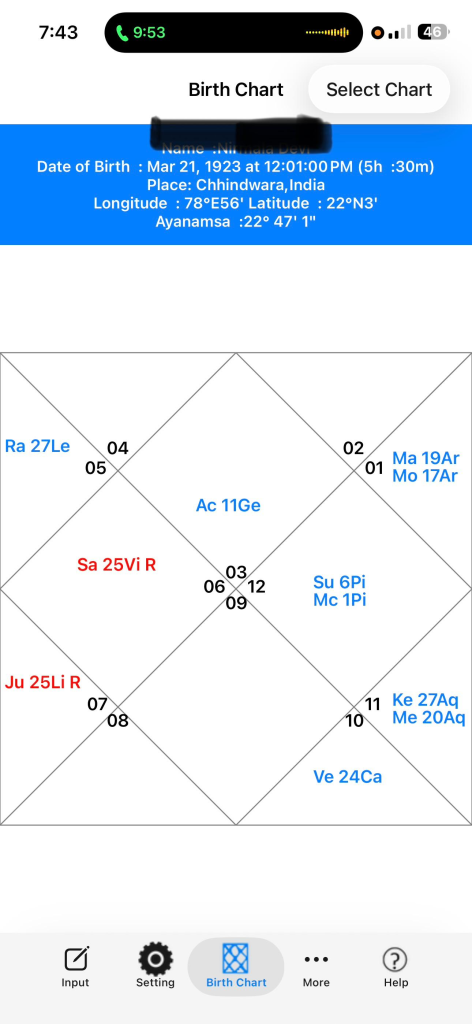
The natal chart shows Gemini Lagna around 11°. Mercury therefore becomes the Lagna lord.
Gemini is traditionally associated with communication, teaching, intellectual exchange, adaptability and the transmission of ideas. This becomes particularly interesting because Mercury appears in Aquarius in the 9th house, together with Ketu.
The 9th house traditionally governs dharma, philosophy, higher knowledge, teachers and spiritual traditions. Mercury there suggests communicating or explaining philosophical knowledge, while Aquarius gives the symbolism a broader, collective or universal orientation.
Mercury with Ketu can traditionally be read as an intellect that does not remain satisfied with conventional explanations. It may seek what lies behind doctrine, ritual or inherited belief.
So one major astrological theme would be:
knowledge → spiritual inquiry → communication of that knowledge to a wider collective.
2. Sun in Pisces in the 10th — spiritual ideas entering public life
The D1 Sun is in Pisces in the 10th house.
The 10th is the domain of karma—public action, vocation, responsibility and one’s visible contribution to the world.
Pisces, meanwhile, is traditionally associated with transcendence, compassion, dissolution of boundaries and spiritual concerns.
Within astrological symbolism, this can indicate a life in which spiritual or universalistic ideas become part of one’s public work, rather than remaining a private belief.
The placement is especially interesting because Jupiter, ruler of Pisces, is prominent elsewhere in the chart.
3. Jupiter in the 5th — teacher symbolism
Jupiter appears around 25° Libra, retrograde, in the 5th house.
The 5th house is associated with intelligence, teaching, students, creativity, mantra, accumulated merit (purva punya) and transmission of knowledge.
Jupiter is the classical Guru.
So Jupiter occupying the 5th gives strong traditional symbolism for:
teacher → knowledge → students → transmission.
Because Jupiter is also the 10th-house lord for Gemini ascendant, there is an interesting connection between profession/public activity and the 5th-house domain of teaching.
In other words, Jyotisha would read this as someone whose karma can become closely associated with educating, guiding or transmitting a body of knowledge.
4. Moon + Mars in Aries in the 11th — mobilising groups
The D1 has Moon and Mars together in Aries in the 11th house.
This is a powerful combination.
Aries is active, pioneering and initiating. Mars is in its own sign, so it is particularly strong.
The 11th concerns networks, organisations, communities, large groups and the fulfilment of objectives.
Astrologically, this is quite different from the image of a secluded mystic meditating alone.
It suggests considerable capacity for mobilising people and turning an idea into collective activity.
Moon adds public/emotional connection; Mars adds drive.
So the chart repeatedly shifts from the individual toward the collective.
5. Rahu in the 3rd — unconventional mass communication
Rahu appears in Leo in the 3rd house.
The 3rd governs communication, courage, initiative, writing, speaking and dissemination.
Rahu tends to enlarge, cross boundaries and use unconventional routes.
Traditional interpretation could therefore associate this with bold or non-traditional communication, especially communication intended to reach beyond one’s immediate cultural environment.
Interestingly, Ketu is simultaneously sitting with Mercury in the 9th.
That creates an axis:
3rd house — communication
↕
9th house — spiritual/philosophical knowledge
That is one of the more interesting signatures in this horoscope.
6. Venus in Cancer in the 2nd — gentle speech and a familial mode of communication
Venus appears in Cancer in the second house.
The second house includes speech, values and family. Venus tends to soften and harmonise what it touches; Cancer adds nurturing and maternal symbolism.
Astrologically this could indicate that communication is not merely intellectual. There can be a distinctly affectionate, nurturing or familial quality in the way ideas are presented.
This is worth contrasting with the fiery Moon-Mars combination: the horoscope symbolically combines softness of presentation with considerable force of action.
7. Saturn retrograde in Virgo in the 4th — discipline beneath the nurturing exterior
Saturn in the 4th adds a very different tone.
The 4th traditionally represents one’s inner foundation, home, emotional base and sense of belonging. Saturn here can indicate seriousness, discipline, responsibility and endurance in these areas.
Because Saturn is the 9th lord for Gemini ascendant, its placement also connects dharma with the 4th-house idea of the inner foundation.
One could symbolically summarize this as:
Spirituality is not merely an intellectual philosophy; it must become internally established.
The D9 is particularly interesting
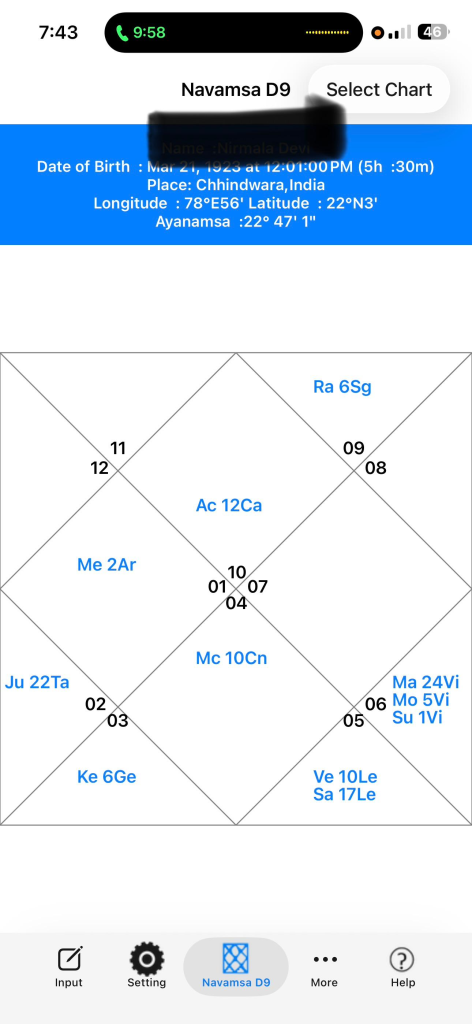
The Navamsha screenshot appears to show Capricorn rising.
The D9 is traditionally used to examine the deeper maturation of the natal promise and dharma.
What immediately stands out is the concentration in Virgo: Sun, Moon and Mars.
Virgo is traditionally associated with discrimination, purification, correction, service and detailed practical work.
This gives the deeper chart a surprisingly practical quality.
The spiritual orientation suggested by the D1 therefore isn’t simply dreamy or abstract. The Navamsha symbolism pushes toward:
discernment + discipline + practical transformation.
Jupiter in Taurus and Venus-Saturn in Leo further reinforce the mixture of values, responsibility and sustained expression.
The D60 is extraordinary-looking—but should be treated cautiously
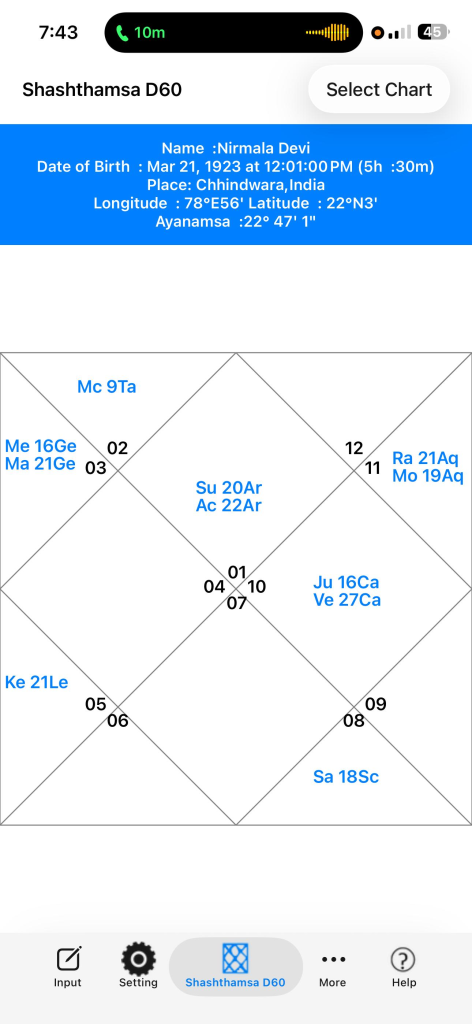
Your D60 screenshot shows Aries rising with Sun in Aries, while Jupiter and Venus appear together in Cancer.
In traditional Jyotisha, both are conspicuous because the Sun is exalted in Aries and Jupiter is exalted in Cancer.
That would normally be interpreted as an unusually powerful Shashtiamsha.
There is also Moon-Rahu in Aquarius, again bringing in a collective or unconventional dimension.
However, I would not build major conclusions from this chart until the birth time is independently established to very high precision. D60 changes extremely rapidly. A seemingly tiny birth-time correction can produce an entirely different D60 ascendant and house structure.
D40: another spiritual/ancestral layer
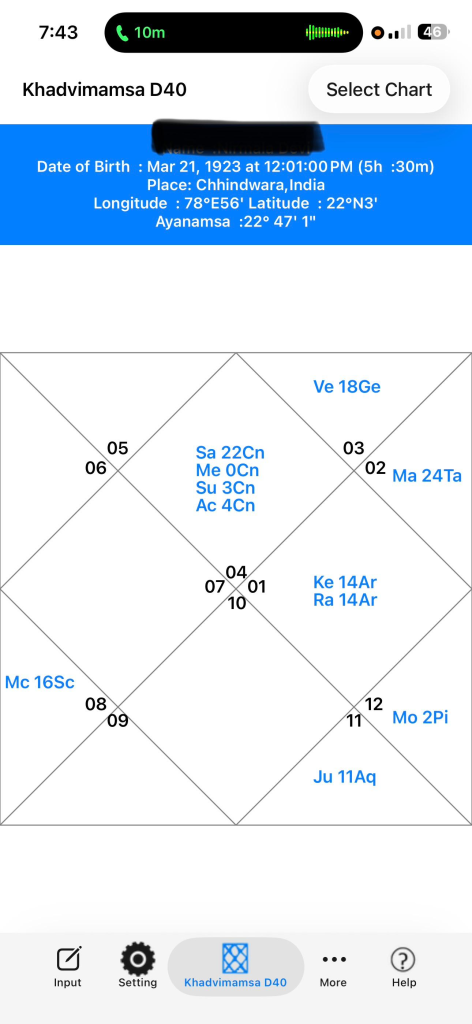
The D40 screenshot appears to have Cancer rising, with Saturn, Mercury and Sun concentrated in Cancer.
Jupiter appears in Aquarius, Moon in Pisces and the nodal axis in Aries.
Traditionally D40 is used primarily for subtle auspicious/inauspicious inherited influences rather than ordinary personality prediction.
The presence of Moon in Pisces and Jupiter in Aquarius nevertheless repeats something already visible much more reliably in D1:
spiritual sensitivity + collective orientation.
That repetition across charts is more interesting than an isolated divisional placement.
The strongest repeating pattern
If I deliberately ignore the identity attached to the chart and read only the astrological symbolism, I would characterize its central traditional themes as:
communication of knowledge → spiritual/philosophical inquiry → teaching → public activity → organisation of communities → expansion beyond a narrow social boundary.
There is an unusual combination of Guru symbolism and collective symbolism.
The chart does not read, in traditional terms, primarily as someone whose spirituality remains private. The 9th, 10th, 11th, 5th and 3rd-house themes repeatedly connect knowledge, teaching, public work, communication and groups.
The tension is equally interesting: Mercury-Ketu can question established intellectual structures; Rahu in the 3rd can communicate unconventionally; Mars in Aries can act forcefully; yet Venus in Cancer gives a softer, nurturing mode of expression.
So, strictly as a Jyotisha reading, I would expect the person’s life story to contain a progression something like:
searching/questioning → discovery of a spiritual or philosophical framework → teaching it → developing a public mission → gathering people around it → taking that teaching beyond its original geographical or cultural setting.
That is an interpretation of the traditional astrological symbolism, not evidence that astrology predicted what actually happened.